
What is the deal with chiropractic?
You may have heard that it has an interesting history. Did D.D. Palmer, the founder of chiropractic, really claim he got chiropractic from a ghost? Is it true that early chiropractors thought every condition in the human body could be treated with a spinal adjustment? Did chiropractors actually go to jail for practicing in the early 1900s?
As they say, there is a little bit of truth in everything.
In this article I want to walk through some of the fascinating history of chiropractic — the séances, the jail cells, the AMA lawsuit that took 30 years, and whether early chiropractors even agreed with D.D. Palmer’s theory (spoiler: a lot of them didn’t). Then I want to make the case for why the part that matters most isn’t the history — it’s where the profession is now and where it’s going.
A lot of what follows draws on Kaptchuk and Eisenberg’s 1998 paper in Archives of Internal Medicine, which is still one of the best historical reviews of chiropractic out there.
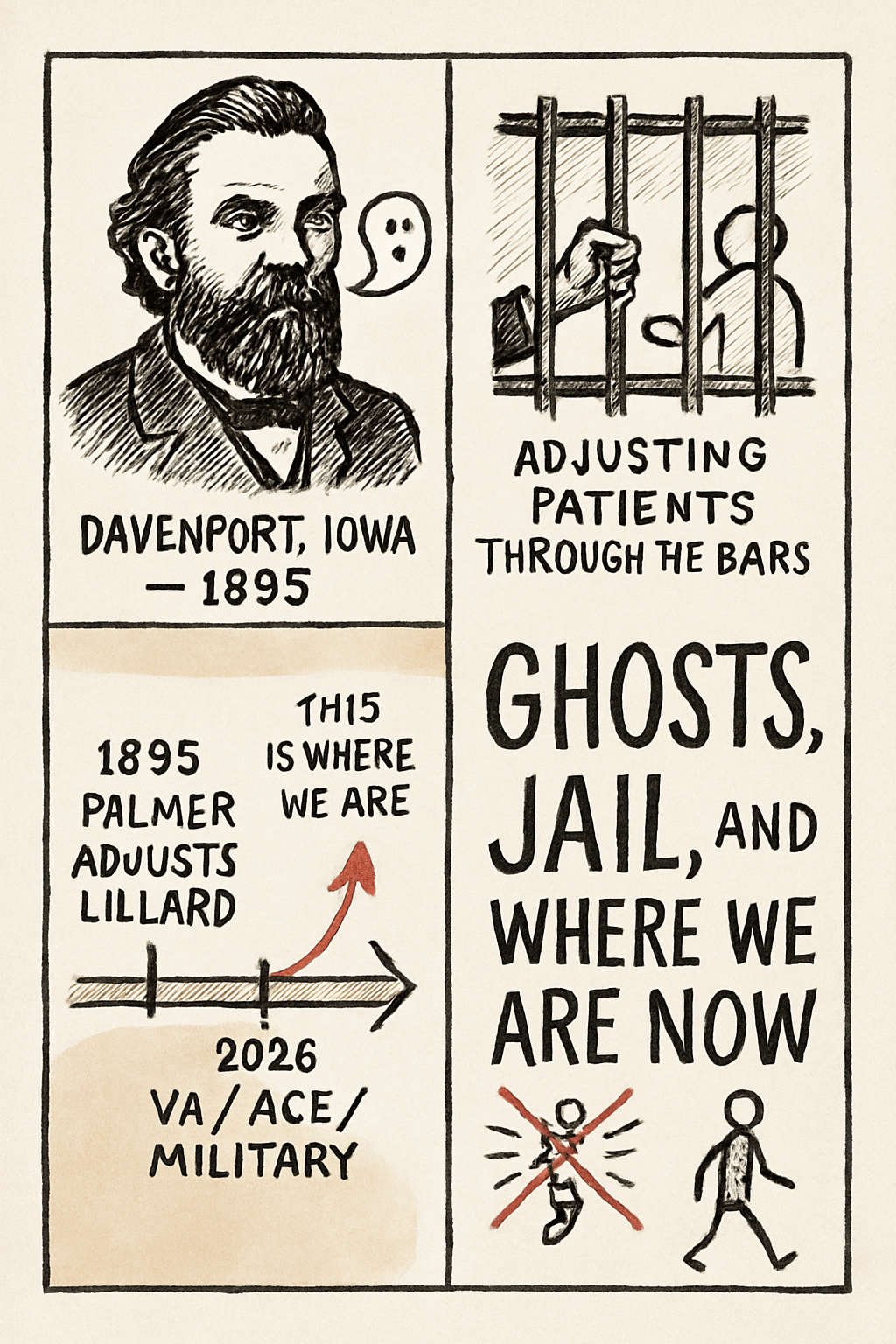
1895: A Magnetic Healer Adjusts a Janitor
Chiropractic begins in September 1895, in Davenport, Iowa, in the office of a man named Daniel David Palmer — D.D. Palmer for short. He wasn’t a physician. He was a magnetic healer, a popular alternative practice of the time involving the laying-on of hands and the supposed manipulation of bodily energy.
The founding story goes like this: Palmer treated a deaf janitor named Harvey Lillard. Lillard told him that years prior he had felt a “pop” in his upper back while bending over, and shortly after lost most of his hearing. Palmer felt along Lillard’s spine, found what he believed to be a displaced vertebra, and gave it a thrust. Lillard, the story says, regained much of his hearing.
Whether the event happened exactly as Palmer described is a separate question. (The auditory nerve isn’t anatomically connected to the upper-thoracic spine in any way that would explain such a recovery.) But that moment is the founding myth of the profession. From it, Palmer extrapolated a theory: misalignments in the spine — which he called subluxations — press on nerves and disrupt the function of organs and tissues throughout the body. Correct the subluxation, restore function, treat disease.
That theory gave the profession a name (chiropractic, from the Greek cheir + praktos: “done by hand”), a method (the spinal adjustment), and an identity. It also planted intellectual problems the profession would spend the next 130 years working through.
Did the Founder Really Claim He Got Chiropractic from a Ghost?
Yes — at least, sort of.
D.D. Palmer was deeply involved in spiritualism, a major movement in late-19th-century America. Spiritualists believed the dead could communicate with the living through mediums and séances.
In his own 1914 book, The Chiropractor, Palmer wrote that the foundational principles of chiropractic had been transmitted to him during a séance by the spirit of a deceased physician named Dr. Jim Atkinson. He framed chiropractic as a kind of “religious revelation” — the next great spiritual healing science, comparable to the founding of Christian Science.
You can read this two ways. One: Palmer was a 19th-century spiritualist for whom communicating with the dead was an ordinary cultural practice, the way going to a yoga class is ordinary today. Two: the founder of an entire healthcare profession openly attributed its theoretical underpinnings to ghostly dictation. Both readings are correct simultaneously. Pretending otherwise is bad history.
It also matters less than people think — for reasons we’ll get to.
”We Can Treat Everything” — And the Split That Followed
Early chiropractic, as taught by Palmer and especially by his son B.J. Palmer, made extraordinary claims. The dominant theory was that subluxations caused interference in the flow of “innate intelligence” through the nervous system — and that this nerve interference was responsible for virtually every disease: not just back pain, but ulcers, asthma, infectious diseases, cancer, deafness, blindness, infertility, and more. Germ theory was rejected by some. Vaccination was opposed. Medicine, as practiced by MDs, was declared largely unnecessary.
This was, to put it gently, a lot of theory built on a single janitor and one man’s spiritualism.
But here’s the underappreciated part: almost from the beginning, the profession split in two.
- The “Straights” followed B.J. Palmer’s pure subluxation theory — adjustment only, no exercise, no modalities, treat the subluxation and the body does the rest.
- The “Mixers” said: yes, manipulation works, but so do exercise, soft tissue work, nutrition, and patient education. They were more willing to acknowledge limits and refer out when appropriate.
This wasn’t a footnote. It was a generational, profession-defining argument that led to schisms in chiropractic schools and separate professional associations. Many of the chiropractors most respected today — clinically and academically — descended from the Mixer tradition.
In other words: even at the founding, a meaningful portion of the profession was already saying “the theory is wrong, but the manual technique is useful.” The profession was self-correcting, slowly, from very early on.
Jail Cells, Antitrust, and the Long Road to Legitimacy
In the early 20th century, practicing chiropractic was illegal in much of the United States. State medical boards prosecuted chiropractors for practicing medicine without a license. Hundreds — possibly thousands — were arrested.
Many refused to pay fines and went to jail instead, treating it as civil disobedience. B.J. Palmer reportedly kept a list of jailed chiropractors at the Palmer School as a badge of honor. There are well-documented cases of chiropractors continuing to treat patients from jail cells — adjusting people through the bars.
This era ran from roughly 1907 into the 1920s and 30s, gradually winding down as states passed licensure laws. The last state to license chiropractors was Louisiana, in 1974.
But the conflict didn’t end there. The AMA’s “Committee on Quackery” had a stated goal of “the containment, and ultimately the elimination, of chiropractic.” MDs were prohibited from associating with, referring to, or accepting referrals from chiropractors.
In 1976, chiropractor Chester Wilk and four colleagues filed an antitrust lawsuit against the AMA. The case — Wilk v. American Medical Association — took 14 years to resolve. In 1987, a federal judge ruled that the AMA had engaged in “an unlawful conspiracy in restraint of trade.” The ruling was upheld on appeal in 1990. The AMA was forced to permit interprofessional cooperation.
That ruling is part of why a chiropractor and an orthopedist can coordinate care today without anyone losing a license over it.
So Where Are We Now?
Here’s the part that actually matters.
In 2026, chiropractic is a regulated, licensed healthcare profession in all 50 states, integrated into:
- The Veterans Health Administration — chiropractic is a covered VA service (see our veterans page)
- The U.S. military — every branch employs chiropractors at major medical facilities
- Major hospital systems as part of integrated MSK and pain-management programs
- Clinical practice guidelines — the American College of Physicians 2017 low back pain guideline explicitly recommends spinal manipulation as first-line care
- The Lancet Low Back Pain Series (2018), which called for non-pharmacologic care, including manual therapy and exercise, as the foundation of low back pain management
The profession’s research base has grown substantially. Goertz et al. (2018) in JAMA Network Open showed that spinal manipulation added to usual care reduced pain and disability in active-duty military personnel. Whedon et al. have published a long line of cohort analyses showing chiropractic care is associated with substantially lower opioid prescription rates for spine-related pain.
And the subluxation-causes-everything theory? It’s still around in some corners of the profession — but it’s increasingly a minority view. The mainstream of contemporary chiropractic, including most educational programs, the licensing exams (NBCE), and the major professional associations, frames the work in musculoskeletal medicine terms. Manipulation is one tool in a multimodal MSK toolkit, alongside exercise, soft tissue therapy, shockwave therapy, education, and rehab.
That’s how we practice at Body of Health. No subluxation theory. No “innate intelligence.” No “we can cure your asthma.” Just evidence-informed care for the conditions we’re actually good at.
Key points:
- D.D. Palmer founded chiropractic in 1895 after adjusting a deaf janitor; he later attributed the principles to a séance with a deceased physician.
- Early chiropractic claimed to treat virtually all disease via spinal adjustment — a theory much of the profession has long since abandoned.
- The Mixer/Straight schism existed almost from the beginning. Plenty of early chiropractors disagreed with Palmer’s theory.
- Hundreds of chiropractors were arrested and jailed for practicing in the early 20th century.
- Wilk v. AMA (1976–1990) ended the AMA’s organized boycott and opened the door to interprofessional care.
- Modern chiropractic is a licensed, regulated MSK profession, integrated with the VA, the military, and major hospital systems, and supported by mainstream clinical guidelines.
Where Is the Profession Going?
A few things look likely from where I sit:
- Closer integration with mainstream healthcare. More referral relationships, shared electronic health records, participation in coordinated MSK programs.
- A continued narrowing of scope toward MSK medicine. The profession’s research, training, and reimbursement landscape all push in this direction.
- Better diagnostic specificity. As imaging, exam protocols, and clinical reasoning improve, “low back pain” stops being a single label and becomes a set of distinct presentations with distinct best treatments.
- Generational turnover on the subluxation question. New graduates today are far less likely to be taught Palmer-era theory as gospel.
- More research per practitioner, especially in sports rehabilitation, post-traumatic care, and the integration of shockwave and other tools alongside manipulation.
The profession that started in Davenport with one janitor, one séance, and a lot of ambitious theorizing is, 130 years later, a serious clinical discipline that helps millions of patients per year with conditions where the evidence supports the care.
The history is fascinating. It’s also not the most important thing about us anymore. When you walk into a clinic like ours in Corvallis — or our coming Albany location — what you’re getting isn’t D.D. Palmer’s spiritualism. It’s a focused exam, a real diagnosis, a plan grounded in current research, and care that ends when you’re better.
Which is, I think, a pretty good place to land.
References
- Kaptchuk TJ, Eisenberg DM. Chiropractic: Origins, Controversies, and Contributions. Archives of Internal Medicine. 1998;158(20):2215–2224. PubMed
- Palmer DD. The Chiropractor. Beacon Light Printing Company, 1914. Internet Archive
- Wilk v. American Medical Association, 895 F.2d 352 (7th Cir. 1990). Case summary
- Qaseem A, Wilt TJ, McLean RM, Forciea MA. Noninvasive Treatments for Acute, Subacute, and Chronic Low Back Pain: A Clinical Practice Guideline From the American College of Physicians. Annals of Internal Medicine. 2017;166(7):514–530. PubMed
- Foster NE, Anema JR, Cherkin D, et al. Prevention and Treatment of Low Back Pain: Evidence, Challenges, and Promising Directions. The Lancet. 2018;391(10137):2368–2383. PubMed
- Goertz CM, Long CR, Vining RD, et al. Effect of Usual Medical Care Plus Chiropractic Care vs Usual Medical Care Alone on Pain and Disability Among US Service Members With Low Back Pain. JAMA Network Open. 2018;1(1):e180105. PubMed
- Whedon JM, Toler AWJ, Goehl JM, Kazal LA. Association Between Utilization of Chiropractic Services for Treatment of Low Back Pain and Use of Prescription Opioids. Journal of Alternative and Complementary Medicine. 2018;24(6):552–556. PubMed
This information is provided for educational purposes and should not replace personalized medical advice from a qualified healthcare professional.
Made it to the end. Want the next one in your inbox?
Evidence-informed musculoskeletal content from Dr. Jason Young. One email when something new lands. Unsubscribe anytime.